Warren Moon won five Grey Cups in Six Seasons in the CFL
“The Gateway To The North” Cards for the 1981 Edmonton Eskimos for Retro SOM Pro Football
Warren Moon won five Grey Cups in Six Seasons in the CFL
“The Gateway To The North” Cards for the 1981 Edmonton Eskimos for Retro SOM Pro Football
“On the Prairie” Cards for the 1981 Saskatchewan Roughriders and Calgary Stampeders for Retro SOM Pro Football
“The Beasts of the East” - Cards for Retro Canadian Football 🏈 for SOM Pro Football
“Forever Playoff Rivals” - Retro Cards for the 1981 B.C. Lions and Winnipeg Blue Bombers for SOM Football 🏈
(The other two teams might lack talent, but that is not a problem with these two!)
PDF cards for the 1981 B.C. Lions and Winnipeg Blue Bombers.
SOM PRO FOOTBALL LINKS
1981-Lions-and-Blue-Bombers.docx (Roster Sheets)
Whether it’s the mosquitoes, The Forks, Bachman Turner Overdrive or that iconic portrait of the Queen that used to overlook the ice at the old hockey arena, there is always something unique that comes to mind when someone mentions the city of Winnipeg. One thing that hasn’t changed over the last 90 years is the presence of their football team. And that leads us to our this latest 1981 history project. The B.C. Lions and Winnipeg Blue Bombers have engaged in some classic battles over the years. There were two memorable Grey Cup meetings, a nasty West Division rivalry in the 80s, a crazy Lions come back in 2016 and a whole lot more.
Prior to the original Montreal Alouettes shutting down in 1987, the Bombers were a West Division Club. The 80s opened with the Winnipeg Blue Bombers stuck behind an Edmonton Eskimos dynasty that won five straight Grey Cups from 1978-82 – losing to the eventual champions in both the 1980 and 1982 West Final – before closing the chapter on that dynasty with a victory in the 1983 West Semi-Final. Martin Scorsese himself would have a hard-time directing or writing some of the epic Western battles between these two teams prior to their first 1988 Grey Cup meeting (Winnipeg was in the East by then).
Trainers administer to Lions WR John Pankratz during the WC Semi-Final
And that first playoff meeting with the Lions in that memorable decade was a 15-11 B.C. victory in the 1981 Western Semi-Final. While it was an unexpected and epic win - Winnipeg had dominated the Lions during the regular season, winning both prior games- few would remember it, simply because the Lions then fell to Edmonton in the division final the following week. It’s a pity the Lions- Bombers game is not available on YouTube, because it featured an array of 6 and 7 defensive back sets interspersed with a 4-4 “Swarm” blitz rotation on running downs.
CFL teams normally deployed 5 defensive backs. In those days a 5-1-6 or 5-7 defense as a base set in a playoff game, as the Lions unfurled versus Dieter Brock, was quite a risk, but B.C. had used such defensive trickery to hold the powerful Hamilton Tiger Cats and Saskatchewan Roughriders to one combined touchdown in the two prior immediate games after the team had lost five out of six. The win against Saskatchewan in particular had saved their season. The Lions’ Western Semi-Final win thus cemented their place as one of the top teams in the 1981 CFL.
Now 70, former Long Beach State QB Joe Paopao had a long career as a signal caller and coach in the CFL.
But in reality both teams were loaded. B.C. finished 10-6 and featured two all-Canada players on offense in C Al Wilson, a seven time Divisional All Star who is also in the Hall of Fame, and Larry Key, a former Florida State player who finished second in the league in rushing yards, and topped it with 19 total major scores. QB Joe Paopao had his best year throwing to Tyron Gray, who tallied 1481 yards and 9 scores, TE Ricky Ellis (of the USFL’s LA Express) and flanker Al Charuk. The defense had a couple fine players in Nick Hebeler, a strong pass rushing end, and LB Glen Jackson.
Dieter Brock unloaded for 4,796 yards in 1981, just shy of Dan Fouts’ record of 4,802 yards set that fall.
Winnipeg finished in second at 11-5 in the rugged West, and they had Brock, who was the Most Outstanding Player of the CFL (although on film I would say Warren Moon of the Esks looks more formidable), and a pair of divisional all-stars in ends Joe Poplawski and Eugene Goodlow, who led the league with 14 TD catches. Goodlow caught a franchise record fifteen passes in the regular season finale to become the first CFL player with 100 catches. Rick House also became a third thousand yard target, with 81 catches, over 1100 yards, and 10 major scores. All- Canadian guard Larry Butler and versatile HB Obie Graves rounded out an elite offense. On defense end Pete Catan, MLB James Reed, and defensive backs Charlie Williams and Reggie Pierson allowed the second fewest points in the CFL and the team posted the second best turnover differential. Trevor Kennerd, the Blue Bomber placekicker, led Canada in scoring and made field goals, setting the league record with 39 makes as well as seven in one game.
Winnipeg had won their last six in the regular season by frightful scores (an average margin of over 28 points!) and the team had every reason to look forward to playing Edmonton for the West Division championship and a chance at the Grey Cup, but they stumbled versus the Lions and would, instead, have to wait.
The meat of this rivalry then came Post- Empire Stadium, the traditional outdoor Lions den in Vancouver. The two teams played in three consecutive Western Finals at the new domed BC Place from 1983-85. The Lions 39-21 victory in ’83 in front of 60,000 fans at the new dome was special for a lot of reasons. It was the first division final played in Vancouver since 1964.
Eventually, the ’84 Bombers ended what had then been the longest championship drought in franchise history – dating back to 1962 – by beating the Eskimos at home, knocking off the Lions on the road and then eviscerating the Hamilton Tiger-Cats in the Grey Cup.
If the 50s and 60s were the Golden Era for Winnipeg Football, the Eighties were Golden Era 2.0. For both teams, they hit each other just a little bit harder in the Eighties, each knowing what was at stake. And even now, they are still Forever Rivals once they meet in the playoffs.
Fred Bobberts
Initial Date of Publication - 7/8/2025
Retro Pro Football 🏈 cards for Les Alouettes de Montreal and the Toronto Argonauts of the 1981 CFL Eastern Division
Lineupscfl6-30.pdf (PDFs of the 1981 Montreal Alouettes and Toronto Argonauts)
Rosters 1981-Argonauts-and-Alouettes.docx
Note to my Canadian friends (this means you, Nez1, jiggypop, leespurge, and the rest !) I promised you guys Canadian football teams, but not necessarily good Canadian football teams. These are fun prototypes for scrimmages though, and I will eventually build this out.
The 1981 CFL season was its 28th, but it is considered the 24th official season. It’s a very cool season to me because it has the original lineup of nine Canadian- only teams in two divisions; 1981 was the first CFL year where every team played the other teams “home and home” for a balanced schedule. The CFL then had both Rough Riders and Roughriders, with the latter based then (as now) in Saskatchewan and the former in Ottawa, now called the Redblacks.
I’ve chosen 1981 because long ago a guy named Gerry Parsh sent me a mountain of info on this season when he left the hobby, including bits from a game called “Sports Action Football”. Sports Action Football looked a lot like APBA, suspiciously so, but when I realized you could card a defense to have a twelfth man in coverage I immediately saw the Strat-O- Matic possibilities. I owe Gerry a deep debt; he loved both the CFL and Fifties NFL Football.
Sports Action Football Rules, c1977
And being a Detroiter, I loved Canada, from Ouellete Street, to the Queen’s Highway, from the Gardens (and Seagrams VO plant) in nearby Amherstburg to the Windsor Ballet.
They did things differently in Canada; laundry detergent and petrol pumps there had instructions in two languages and you paid by the litre. While the Tigers stacked their lineups with slow moving lefties who took dead aim at the overhang in right field with middling success, the Expos stole Ron LeFlore, our only decent baserunner, in 1980 and then swiped 237 bases in a season, about a decade’s worth of work in Detroit. I watched all this on CBC, along with the CFL, when I got lucky and they were televised.
For these two teams 1981 was a season of change. The Montreal Alouettes had won Grey Cups in 1970 and 1977 but had fallen on hard times, and they chased respectability by bringing in “imports”, in many cases players with NFL experience. Chief among these for 1981 was Vince Ferragamo, who had taken the Rams to Super Bowl XIV and had thrown 30 TDs in 1980. In 1981, Ferragamo jumped to the Montreal Alouettes, thanks to a $600,000-a-year contract. This was a large amount back in the day even by NFL standards, especially compared to $250,000 the Rams offered him, and the $47,500 they had paid him for his fine work in 1980. Being immobile in a mobile QB’s league, Ferragamo had a difficult time adjusting to the style of the CFL, completing 175 of 342 passes (51.2%) for 2,175 yards, with only seven touchdown passes against 25 interceptions. He was demoted to the backup position for Gerry Dattilio in the latter half of the season and then to third-string quarterback for the final three games after Ken Johnson arrived from Calgary in a trade.
The Alouettes had David Overstreet from Oklahoma, the leading ball carrier in the East Division, a CFL Hall of Famer in end Peter Della Riva, Billy “White Shoes” Johnson had one good year up there before coming back to the NFL in 1982, and they fielded an All-Canadian receiver in former Chicago Bears star James Scott. But they could not put all the pieces together and finished 3-13. Amazingly enough they made the playoffs under the tiered system of the time, but their season ended when they got pipped by Ottawa 20-16 in the first round.
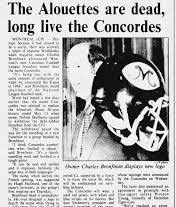
Ferragamo’s contract sank the Alouettes. Suffering big losses the team folded with $2m in debt after 1981, and Nelson Skalbania was replaced under new ownership by Charles Bronfman, the owner of the Expos. The team was renamed the Concordes, but they would soon reorganize again, and they would not be Grey Cup winners until 2002.
The Toronto Argonauts are the New York Yankees of the CFL, but no self-respecting Canadian will appreciate the parallel even if there is some truth to it. They have won the most (19) Grey Cups including this past year’s contest, in 2024. But during this arcane post-War period they actually went 31 years between Cups, starting on November 29, 1952 and ending on November 27, 1983. Argo QB Condredge Holloway is a good example of a good QB on a bad team; he had help in players Bruce Clark and Bob Gaddis, but while his season was up and down, Holloway’s surrounding cast wasn’t healthy or explosive, and the defense was terrible. Better days were ahead for Holloway, who would be the outstanding player in the CFL the next year. The 1981 Argos finished 2-14 and were knocked out of the running for the East playoffs in the season’s final week.
A few comments on Rouges/ Simples and the game in general;
The kickers have red numbers in their FG misses. If you hit this number or range it’s an automatic single. But if you miss a FG then the other team follows this sequence of play: